
Roots in the Fuhrman Land
March 30, 2026.
I’m standing on the Fuhrman land in Etowah County where the wind is so breezy today it’s literally bending the bushy bluestem. The tall, silvery plumes sway like they’re waving at old ghosts.
Tomorrow is Palm Sunday, the day we remember Jesus riding into Jerusalem on a donkey, welcomed with palm branches and shouts of “Hosanna.” Standing here the day before feels especially sacred to me—a quiet reminder of humility, roots, and the things that endure even as the world changes. I know soon enough all of this could be gone, swallowed by subdivisions and progress. But right now, on this lazy, windy Saturday afternoon, Nathan’s black Angus herd rests peacefully in the sunlit pasture, their dark forms scattered across the green field like living pieces of the land itself—“He makes me lie down in green pastures; He leads me beside still waters” (Bible, Psalm 23:2), a verse that feels alive out here.

Even though there’s no ball in the pasture, two heifers are playfully butting heads—struggling horn to horn as they test each other to control the herd—while a small calf wanders nearby, all of it happening right under the shade of a massive oak tree. That oak has stood on this land long before the Fuhrmans owned it, all the way back to my ancestors who settled the Southside community 195 years ago as the Cherokee were forced west on the Trail of Tears. Like the oak, “the righteous shall flourish like the palm tree… planted in the house of the Lord” (Psalm 92:12–13), rooted deeper than time itself.
These fields roll gently down toward the bend in the Coosa River and stretch all the way to the foothills of the Appalachians. Lines of tall trees cast long shadows across the grass under a bright blue sky—reminding me that “to everything there is a season” (Ecclesiastes 3:1), and this moment, like all others, is both fleeting and eternal in its own way.
Yet in one spot there is now just an old empty area around the trees where the Fuhrman family home once stood. My mom had it bulldozed almost two decades ago. The old potato house is gone too—the place where my uncle and aunt once lived. Behind it sat my granddaddy JD Fuhrman’s Ford pickup truck—affectionately known in the Southside community as Buck—the one Uncle Jim shot the roof out of on the passenger side after its engine had long died. It sat there rusting for years. All of those childhood memories—the buildings, the stories, the everyday life of the farm—have faded, leaving just the land itself. “The grass withers, the flower fades, but the word of our God stands forever” (Isaiah 40:8)—and somehow, so does the imprint of a life lived on land like this.
As a child, I hunted these woods with my eight dachshunds. I chased after my daddy’s bird dogs as they ran off with my toys across these open fields. Somewhere in this same pasture lies an old Airedale, a faithful dog buried long ago. I can no longer find the fern that once grew over its grave, a gentle marker now lost to time and the shifting grass. Still, “the memory of the righteous is a blessing” (Proverbs 10:7), and even what we cannot see anymore remains part of who we are.
I helped blow stumps with my daddy and my brother, barely tall enough to see over the bed of his 1967 Dodge pickup with the white top. I rode my horses—Dolly, Ginger, and Dan—along back trails that were nothing more than forgotten roads in Etowah County, long before they became subdivisions.
The land has changed. In places where there were never deer, they roam now. Where there were never armadillos, they scurry through the underbrush. The thorn bushes stand just as stubborn as they did when I was a boy, but for some reason most of the cockleburs are gone. Still, the buzzards circle when something dies, and there’s a kind of peace to this place I can’t put into words—the feel of the red clay underfoot, rich and grounding. It reminds me that “the Lord God formed man of the dust of the ground” (Genesis 2:7), and one day, in ways we don’t fully understand, we return to it.
At 62, I stand here with my salt-and-pepper gray hair hanging long onto my shoulders. What started as a gag—to see if some donor would make a big donation if he could cut it off—has turned into something more. Now it’s my own version of a Charlie Daniels song: “You don’t like the way I’m living, just leave this long-haired country boy alone.”
Nathan keeps his feeder stations cut back in the woods. Some things remain as they were; others have slipped away.
The odd thing is, we just finished the seventh One Yard at a Time Gala. For over a decade and a half I fought to build Lettermen of the USA from whole cloth—pouring everything into honoring veterans, one yard at a time. Somewhere along the way, I forgot about all this—the feel of the red clay, the land, the roots, the quiet graves and lost ferns, the empty spots where homes and potato houses once stood, the fields rolling down to the Coosa, and the cattle resting and playing on afternoons like this. “For what does it profit a man to gain the whole world and forfeit his soul?” (Mark 8:36) echoes a little louder out here.
I’m reminded: “It’s about the land, Katie Scarlett.”
This place shaped me. My grandparents and my father instilled in me a deep love for it—the feel of the red clay between my fingers, the rhythm of the seasons, the quiet lessons it teaches. I lost touch with that feeling for a while, caught up in the hard work of building something meaningful. But I hope I never lose it again. These roots run deep. They are my foundation, my childhood, my teenage years, and the quiet strength I carry forward—especially as we enter Holy Week and remember what truly lasts. After all, “where your treasure is, there your heart will be also” (Matthew 6:21), and mine has always been here.
The photos I took capture it perfectly: Nathan’s black Angus herd resting or playfully butting heads in the pasture on this breezy afternoon under that ancient oak, the wide green fields with their gentle curves, the lines of trees casting shadows across the rolling land, the empty spaces where family structures once stood, and the distant wooded hills under that bright Alabama sky. They show the Fuhrman land still holding on—offering that same indescribable peace even as buildings vanish and the world changes around it.
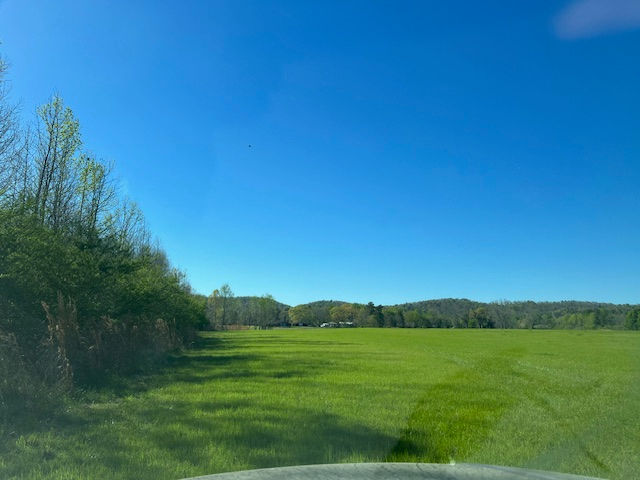
Fuhrman land, Etowah County — March 30, 2026.
From the edge of the field, looking out across the open pasture toward the distant foothills. The land rolls gently down to the bend in the Coosa River, just like it did when I was a boy chasing bird dogs and riding Dolly, Ginger, and Dan. Tomorrow is Palm Sunday, and standing here with the wind in my face and the red clay under my boots reminds me what really matters. At 62, with my long salt-and-pepper hair blowing, I’m grateful the land is still here — even as so much else has changed. Some things fade, but these roots run deep.

Standing in what used to be the front yard of the old Fuhrman family home — a place that no longer exists. My mom had the house bulldozed almost two decades ago, and the old potato house behind it is gone too. Yet the land remains. From this spot I can still feel the red clay under my feet and see the same trees that watched over my childhood. Tomorrow is Palm Sunday, and on this breezy afternoon the grass is green, the shadows are long, and the quiet peace of home still lingers. Some buildings fade, but the roots run deep on the Fuhrman land in Etowah County.

Standing in the pasture on the Fuhrman land where the heifers were playfully butting heads earlier — struggling horn to horn to sort out dominance in the herd. Directly behind that big tree is my mom and dad’s house, with the carport and the old wash house where we’d clean up before supper (as we Southerners like to say). My mother still lives there, and the house still stands. Nathan’s black Angus are grazing peacefully under the afternoon sun, the grass is bright green, and that quiet Southern peace is still here. Tomorrow is Palm Sunday — a good reminder that while so much has changed over the years, the roots and the red clay run deep on this land.

From my mom’s front driveway on the Fuhrman land in Etowah County — March 30, 2026. Nathan’s black Angus herd is resting peacefully in the sunlit pasture, their dark bodies scattered across the bright green grass under a clear blue sky. Tomorrow is Palm Sunday, and standing here the day before feels especially meaningful. This is the same land where I hunted with my dachshunds as a boy, chased my daddy’s bird dogs, and helped blow stumps with my brother. The old wash house and carport are still just behind me, my mother still lives in the house, and the red clay runs deep. Some things change, but the quiet peace of home never does.
Looking out across the Fuhrman land in Etowah County on this breezy March afternoon. These fields roll gently down toward the bend in the Coosa River and stretch all the way to the foothills of the Appalachians. At 62, standing here with the wind bending the grass and the distant hills under that clear blue sky reminds me why it’s always been about the land. Tomorrow is Palm Sunday — a good day to remember roots, humility, and what truly lasts. The red clay is still under my feet, the memories run deep, and the peace of this place is something I hope I never lose again.


Comments