
Life Lessons from a Mentor from the Past
April 21, 2026
You would never have known by his car that he was a wealthy man. He drove a plain gold Crown Vic, nothing flashy, just a solid sedan that looked like it belonged to any regular working man in Tuscaloosa. But the man behind the wheel was Jim Harrison, founder and president of Harco Drug Incorporated, the company that grew from a handful of family stores into a chain of roughly 155 pharmacies across Alabama, Mississippi, and Florida.
While living in Tuscaloosa and attending The University of Alabama, playing for the Crimson Tide football team, I did many different jobs for Harco Drug. I worked in the warehouse sweeping floors and plugging up the pickers that needed to be charged at the end of the day. I worked in store security, in the video department, and I helped set stores for a new organization that Harco Drug, or Mr. Harrison himself, had purchased called the Carport Auto Parts chain, which was later sold to Advance Auto Parts.
Those hands-on jobs gave me a front-row seat to how the business really operated and, more importantly, to the character of the man who built it.
You never knew where you might visit with Mr. Harrison. Sometimes it was in his corner office in the big Harco Drug warehouse building, that beautiful office where I only spent a minute or two at a time. Other times it was outside.

One summer, he offered me an outdoor job if I wanted it. I jumped at the chance. It beat being cooped up in a warehouse. My assignment was to bring life back to the dying desert yard in front of the corporate warehouse. He told me to report to Charles Reinhardt, one of the toughest men at Harco when it came to finances. Charles watched every penny, and he was my boss on that job.
I put together a proposal outlining everything I would need to restore the yard. It was not cheap. But somehow, I convinced him. He approved the whole thing.
Not long after, I was out there working with all the new equipment, hoses, sprinklers, everything, when Mr. Harrison pulled up in that gold Crown Vic. He rolled down the window and said, “Darryl.”
“Yes, sir.”
He looked around at all the new gear and asked, “Where did all this stuff come from to take care of the yard?”
I told him, “Mr. Charles approved it.”
He paused, smiled just a little, and said, “You sold Charles Reinhardt on all of this?”
“Yes, sir.”
He chuckled and said, “Charles must be getting soft.”
That moment told me a lot about him. He noticed everything, even the yard, and he never lost his sense of humor.
One of the clearest lessons he ever gave me was simple. Always be nice to the stock boy, because one day he could be president. He believed that, and he lived it. He treated people the same whether they were sweeping floors or running the company, much like Sam Walton did. He understood that character mattered more than titles.
Mr. Harrison also had a deep appreciation for athletics. He had been a standout athlete himself, playing basketball at Howard College, now known as Samford University. He still holds the school record for most points scored in a single game, 48 points, and was later inducted into the Samford Sports Hall of Fame. That shared understanding of discipline and competition is probably why he took such a genuine interest in my time playing for the Alabama Crimson Tide.
He went far beyond just giving me work. He served as a reference for me on my résumé throughout my corporate career and helped me land my first real job after college with Chesebrough-Pond’s USA, a Fortune 500 company. For a man like him to stand behind a young guy who had swept floors and worked in the yard, that meant everything. It opened doors I could not have opened on my own.
Years later, as founder and president of the Lettermen of the USA, I often find myself wondering what he would think about all of this. I try to apply the same values he lived by, building something meaningful, serving the community, and letting the work speak for itself.
He did not wear his success. No Rolex. No flashy suits. No entourage. Just a quiet pharmacist who understood that real wealth is not about what you show people. It is about what you build when nobody is watching.
He started with small family stores, Central Drug and Druid Drug, and turned them into Harco in 1967. By the time the company merged with Rite Aid in 1997, it had become one of the most respected pharmacy chains in the region. That kind of success does not happen by accident. It happens when a man decides that serving people and treating employees right matters more than anything else.
He understood money as a tool, not a trophy. He could have driven anything he wanted, but he chose that Crown Vic because it got the job done. That told you where his priorities were, on the business, on his people, and on the communities he served.
What stood out even more was how naturally his values showed up in everyday life. He never had to preach. You saw it in how he treated people, whether you were in the warehouse, setting up a Carport Auto Parts store, working on the yard, or just a stock boy trying to figure things out.
He was also good friends with people most of us only saw on television, men like Gene Stallings. When Coach Stallings wrote about his son John Mark, he mentioned his good friend Jim Harrison by name.
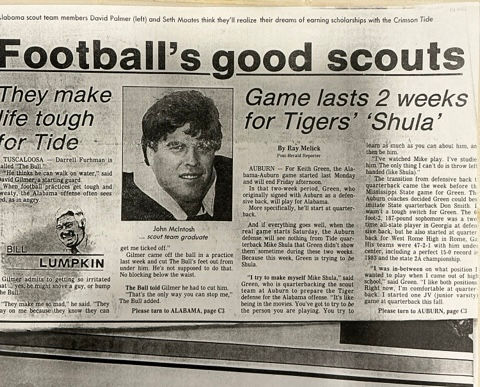
I saw that same kind of care personally. In November 1985, just before the Alabama Auburn game, the Birmingham Post-Herald ran a feature story called “Football’s good scouts” by Bill Lumpkin and Ray Melick. It highlighted the scout team players, the guys doing the tough, unseen work every day. I was one of the players in that article.
Mr. Harrison took copies of that newspaper and passed them out in the Harco Drugs boardroom so everyone could see it. He wanted people to know that one of their own was out there putting in that kind of work.
That small gesture told me more about him than anything else. He celebrated people, even when they were not in the spotlight.
He gave quietly, too. To his church, to education, to causes that helped children and families in West Alabama. He helped build the Harrison School of Pharmacy at Auburn because he believed in giving back. But he never made a show of it. That humility was just who he was.
The biggest lesson I carry from him is this. Real success does not come from chasing attention. It comes from building something that matters, treating people with dignity, and staying true to your values.
I think about him often, especially when I see people chasing the spotlight or measuring success by what they own. I remember that gold Crown Vic pulling up and the man inside it.
A man who took time to encourage a young scout team player.
A man who could laugh about selling a tight fisted finance guy on yard equipment.
A man who reminded me to respect everyone, because you never know who they might become.
A man who stood behind me when it mattered most.
He taught me that the best way to live is to build something meaningful, serve others, and let your work speak for itself.



Comments