
The Hidden Price Behind the Helmet: Trash Cans, Monkey Rolls, and the Making of Legends
May 14, 2026
Most people only see the pictures, the parties, and the glamour.
They see the bright Crimson helmets with the white stripe down the middle and the white numbers on the side. They see the Crimson jerseys, the white pants, the packed stadiums, the television cameras, and 80,000 people screaming on Saturdays. They see the tradition, the legends, and the trophies.
Very few people ever see what it cost to earn the right to wear that uniform.
They never saw the Lower Gym.
They never walked down those basement steps and felt the heat hit them like a wall from the giant heaters blasting at each end of the court, turning that place into a damn sauna. They never saw the old gymnastic mats laid across the floor with gray fifty-gallon trash cans sitting on top of them for one reason only: so players could throw up without slipping in their own sweat.
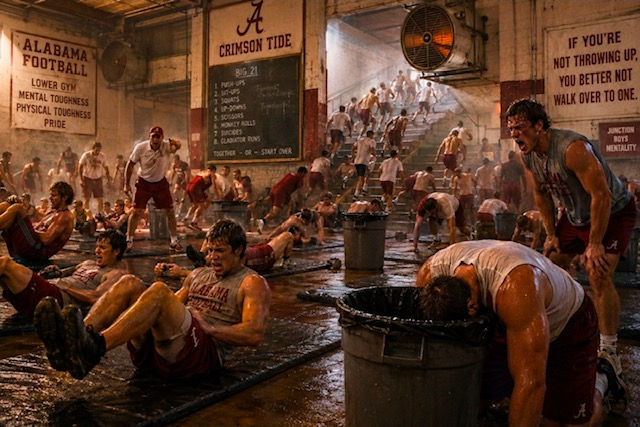
Those cans were not there for decoration. They were there because eventually your body would break.
My teammate Clay Whitehurst remembered four trash cans on each end and a couple near mid-court. David Smith from Southside High School remembered one in each corner. All American Larry Rose confirmed they had more spread around Coleman Coliseum whenever we ran the stairs and concourse. Either way, every one of us knew exactly why they were there.
David said it best. If you were not throwing up, you better not walk over to one.
Those winter workouts still carried the spirit of Coach Bryant’s Junction Boys mentality. Coach Bryant had passed away while I was still in high school, but the standard never left Alabama. I played under Coach Ray Perkins, but the Lower Gym still felt like Bryant’s church.
We would start with stretching before dropping onto the mats for six inches. Holding your legs six inches off the floor does not sound hard until your stomach starts cramping, your legs begin shaking, and a coach is screaming in your face because your feet dropped half an inch too low.
Then came scissors. Legs opening and closing over and over while your heels never touched the ground.
Then came up-downs on those same mats, exploding to your feet and crashing back down until your chest and elbows were raw.
Push-ups and sit-ups became part of what we called the Big 21. One rep each. Then two. Then three. All the way up. But if one guy missed a rep or failed to lock one out, the entire group started over at zero.
That drill taught you something important real fast. Football was never about one man. Everybody paid together.
Chris Mohr reminded me how brutal that part could get because the coaches sometimes targeted certain players harder than others. He also remembered Coach Perkins telling one of the assistants he needed five scholarships back during those Lower Gym sessions.
One player did not even survive fifteen minutes.
Monkey rolls were always the one I dreaded most.
I still remember one morning after the 1985 season when we were deep into a workout and one exhausted teammate yelled out, “Oh God, I’ve died and gone to hell!”
Without missing a beat, one of the coaches screamed back, “No son, you’re at the University of Alabama!”
Every player from that era can still hear moments like that in their head.
Clay Whitehurst also reminded me how much fear those workouts created. I actually switched from the afternoon workout group to the morning group because of it. Guys would barely touch their lunch because they were terrified of throwing up later that day.
Clay laughed and said the only time he ever threw up was when somebody else puked on him. According to him, players at lunch looked horrified when they heard even “Whitehurst” had thrown up during workouts.
My A-Club brother Danny Smith had one of the roughest introductions of all. Danny came from tiny Hayden High School in Blount County as a very green walk-on punter. He had no weight training experience whatsoever when he arrived. In January he walked into the Coliseum and saw the workout board with “M.C.” written under Thursday while every other day had detailed reps and sets. He asked a teammate what “M.C.” meant. The player paused, looked at him, and said, “In a few hours I promise you that you’ll never ask that question again.” Danny quickly learned that M.C. stood for “Mental Conditioning” — also known as the Lower Gym. He became so sore afterward he could barely stand up from a chair. He also learned another hard lesson quickly: Do not let the coaches call your name out for missing reps. If they were willing to destroy a star player, they would absolutely bury a walk-on punter. Danny believes his survival through that brutal introduction is exactly what earned him the invitation back from Coach Bryant. Had he walked on in August like everyone else, it might have been a very different story. Roll Tide.
My A-Club brother Lee Clements remembered those years well too. Fortunately for him, injuries only forced him through two seasons of Lower Gym workouts. One thing he never forgot was watching Rocky Coburn doing box jumps in that suffocating heat until the bottom of his foot literally peeled loose from the friction and temperature.
My teammate Bill Lutz, a former graduate assistant strength coach at Alabama, remembered Rocky Coburn’s leadership in those same sessions. Rocky would yell, “You can’t be a leader in the back of the pack!” and “That easy road ain’t always the best road.” Bill said he couldn’t sleep the night before Lower Gym workouts, lying awake praying he would make it through the gauntlet — then the concourse runs and the stadium steps. That’s exactly when Rocky would start chanting those quotes, pushing everyone forward.
Lee also remembered the gladiator runs up the Coliseum steps. The walkway narrowed in certain places, and if somebody peeled you off your line or you failed to hit your assigned time, you had to turn around and run extra stairs all over again.
One of the games coaches loved was a chase-the-devil style run where the player behind you could tag you. If he tagged you, you owed an extra row of stairs. If he could not catch you, he owed the extra work.
Lee looked back once during one of those runs and saw a huge lineman throwing up into a gray trash can while Jesse Benrose, one of the fastest athletes on the team, was flying up the stairs right behind him.
Lee said he ran like the devil himself was chasing him and somehow beat Jesse to the top that day. Probably the only time in his life he ever did.
It did not matter though. By the time everybody finally reached the gym floor again, guys were crawling back toward the locker room because their legs were trembling too badly to walk.
Years later Lee still shakes his head wondering how he survived all of it.
Then he smiles and says those were good times.
Skill players had to run the mile in 5:45, while linemen had to hit 6:00.
Joe Tipton remembered another savage version of the Coliseum runs where players had to carry teammates on their backs while climbing stairs. Joe drew Joe King, who checked in at 6-foot-8 and 315 pounds in 1985. Carrying that much weight up endless concrete steps after your legs were already destroyed was pure misery.
Gene Newberry remembered how relentless the footwork drills became. Wall jumps. Wall sits. Breakdown sprints across the gym floor while constantly chopping your feet until a coach finally blew the whistle. You only got a few seconds of rest before lining up to do it again.
There was no recovery.
Only pain, movement, sweat, and another whistle coming.
Then after all the calisthenics, footwork drills, monkey rolls, suicides, and gladiator runs were finally over, coaches would turn on the lights and make us play full-contact basketball.
No fouls.
No whistles.
Just football on a basketball court.
Bodies crashing into bodies. Elbows flying everywhere. Players getting knocked into trash cans while everybody fought to prove they still had something left after their bodies were already empty.
Every Lower Gym session was graded by the coaches. If you failed, you had to come back and do the entire workout all over again at 4:30 in the morning with a coach who was extremely mad because he had to leave his wife and his home in the wee hours to come let you make it up.
That was the hidden price behind the uniform.
People saw tradition on Saturdays.
We lived sacrifice the other six days.
My old girlfriend once told me most people only saw the pictures, parties and bows. She was exactly right. They saw the glamour. They saw the bright lights. They saw the Crimson uniforms and the crowds.
What they never saw was the suffering that came first.
They never saw boys being broken down physically and mentally until they either quit or discovered who they really were. Scripture says, “Let us not grow weary in doing good, for at the proper time we will reap a harvest if we do not give up.” Galatians 6:9.
That verse fits because nobody survived those years alone. You survived because your teammates refused to let you quit.
Two hundred walk-ons might show up for spring tryouts, but maybe one or two would survive long enough to make the team. Only a small number of men have ever truly worn that Crimson uniform, and fewer still fully understand what it demanded from them.
That is why it was never just a football team.
It was a brotherhood.
A Crimson bloodline forged through pain, sacrifice, discipline, pride, and the shared understanding that the public only saw the glory while we lived everything hidden underneath it.
This is the hidden altar of Alabama football. No cameras. No cheering crowds. Just brutal heat, gray trash cans waiting for the inevitable, the Big 21 that reset to zero if one man failed, monkey rolls, gladiator runs, and coaches demanding everything you had left — and then some. This is the price paid by every man who earned the right to wear the Crimson jersey and join the Bloodline. Most people see the glory on Saturdays. We remember the suffering that came first. Roll Tide.
This is what it looks like when history stares back at you.
A battle-worn Crimson Tide helmet — cracked, scarred, and still standing proud. The white stripe down the middle. The simple “BAMA” across the front. This isn’t just leather and plastic. It’s a symbol of every brutal Lower Gym session, every 4:30 a.m. makeup workout, every mile run, every monkey roll, and every man who refused to quit when his body begged him to.
Behind the glamour of Saturdays in Bryant-Denny lies the hidden price — the sweat, the pain, the sacrifice, and the unbreakable brotherhood of the Crimson Bloodline.
This helmet didn’t just play the game. It earned the right to wear the colors.

My A-Club brothers Jay Mathews and Lee Clements standing in front of one of the infamous boxes in the Lower Gym — the exact spot where Rocky Coburn did box jumps in that suffocating heat until the bottoms of his shoes literally burned and peeled off from the friction and temperature.
Lee, who lived through those brutal sessions himself, remembered it well and shared the story that still sticks with all of us. This photo captures two young men standing where the Crimson Bloodline was truly forged — not in the bright lights of game day, but in the pain, sweat, and sacrifice of the off-season.
This is what it looked like before the glory. Just two future Alabama football players in front of the boxes that broke bodies and built champions.

The Real Crimson Bloodline — No Cameras, No Glory, Just Grind.
Mid-1980s Alabama football practice. Quarterback Mike Shula leads the pack, flanked by teammates Chester Braggs (over his right shoulder), Ricky Thomas (over his left), and Chris Goode as they push through another brutal conditioning run.
This is what most people never saw — the endless miles, the 5:45 and 6:00 minute runs, the Lower Gym sessions that broke bodies before breakfast, and the silent brotherhood forged in sweat and pain. No cheering crowds. No Saturday lights. Just young men proving they belonged in the Crimson jersey.
This is where the Bloodline was truly earned.
Roll Tide. Forever.


Comments